
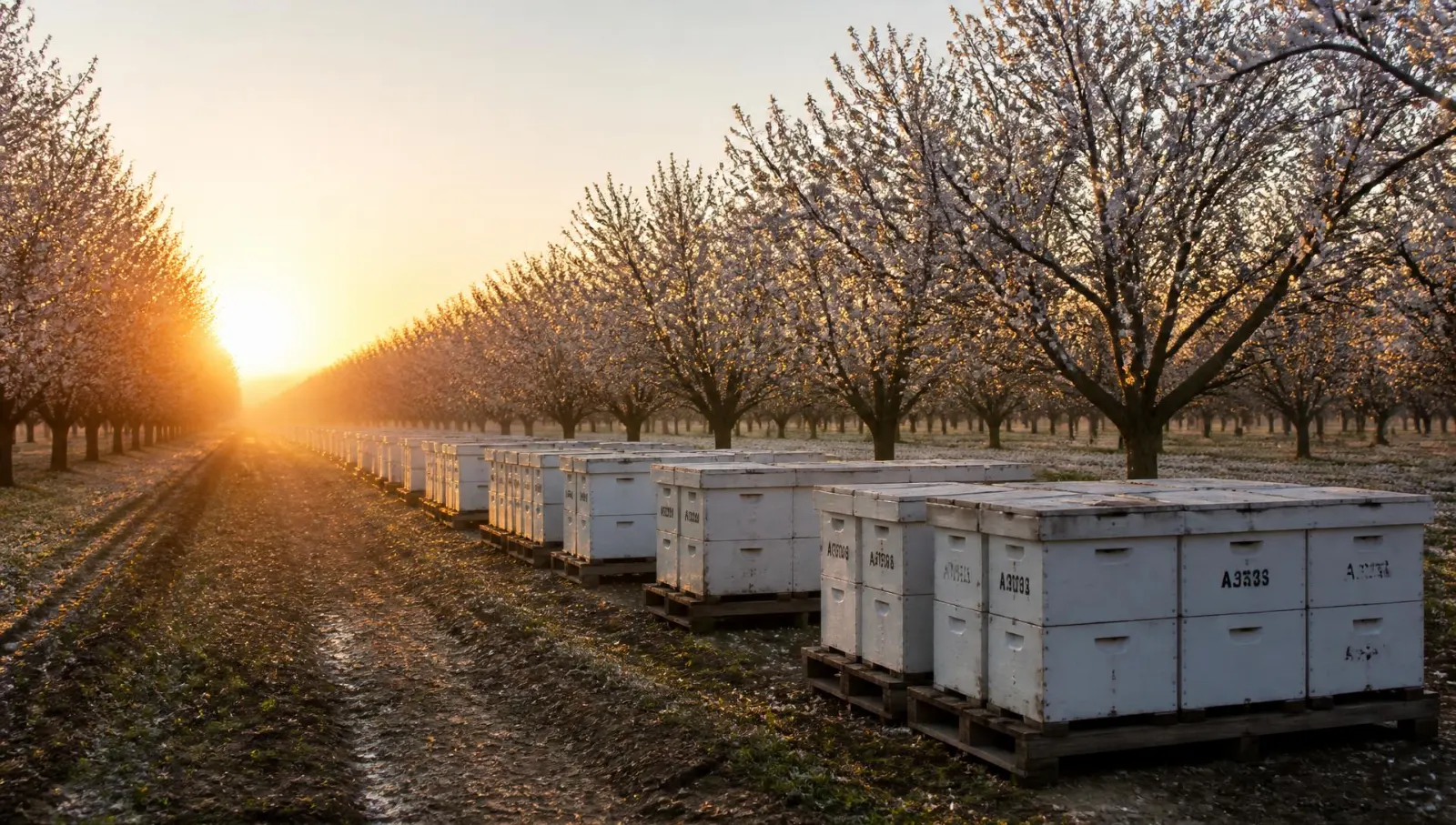
Sacramento Valley
Pollination in Colusa County
Strength-graded colonies for growers around Colusa, Williams and Arbuckle.
Sources: USDA NASS 2026 California Almond Acreage Report (April 2026). Colony estimate is ours, at roughly two colonies per acre; self-fertile varieties need fewer.
Farming in Colusa County
Colusa County farms produced $844.6 million in 2024, led by almonds at $279.0 million on 63,017 harvested acres. Rice, processing tomatoes, walnuts and cattle round out the top five.
Colusa's 2024 report counted 126,034 colonies placed for almond pollination, worth $26.2 million, and $29.3 million in apiary value overall. The county also grew about 1,700 acres of certified and 2,500 acres of non-certified sunflower seed, a crop that brings bees back in summer.
Top commodities by value
- Almonds$279.0M
- Rice$199.8M
- Processing tomatoes$96.0M
- Walnuts$50.8M
- Cattle$44.4M
Gross value, 2024 Colusa County crop report. Sources: Colusa County 2024 Crop and Livestock Report.
What Colusa County growers ask us for
Every February, Colusa County orchards around Colusa, Williams and Arbuckle compete with the rest of the state for strong colonies. California needs well over two million colonies for almond bloom, and only a fraction of them live here year-round. The rest are trucked in, and quality varies.
We grade every colony at delivery against a written frame standard, welcome your inspector, and give you one phone number from drop to pickup. Yolo, Colusa and Sutter growers produce hybrid seed, including sunflower seed. California has historically grown about 95% of U.S. hybrid sunflower planting seed.
Timing and logistics in Colusa County
Sacramento Valley bloom usually opens a little after the southern San Joaquin Valley, so colonies go in from early to mid-February and the first warm, dry afternoons do most of the work. Colusa is about 50 miles (straight line) from our home yard in Rio Linda, close enough for our own trucks and crew to handle delivery, checks and pickup. Colusa County holds about 4.4% of California's bearing almond acres.
Crops we pollinate
- Almonds
Mid-February to mid-March
- Cherries and stone fruit
March and April
- Seed crops
Late spring and summer
- Melons and more
Spring through summer
Grower guides
Answers before you book
- Almond varieties and bloom timing: what it means for pollinationMost almonds need pollen from a different, compatible variety that blooms at the same time. How variety mix shapes your bee plan.
- How bloom weather affects almond pollination: cold, rain, wind and frostBees need about 55°F, light wind and no rain. Here is what bad bloom weather does, and what you can still control.
- How many beehives per acre do almonds need?The short answer is about two, but weather, variety and colony strength change the math.
- All grower guidesStocking rates, costs, frame counts and contracts.
Nearby areas
Part of our Sacramento Valley service region, along with Tehama, Glenn, Butte, Sutter, Yuba, Yolo, Solano, Sacramento, Placer counties.
Need colonies in Colusa County? Send us your blocks or call (916) 249-0711. We reply within one business day.
Your orchard blooms once a year. Make it count.
Colonies for the 2027 almond bloom are being committed now. Tell us about your blocks and we will call you within one business day.